bookshelves buying guide
everything you need to know
a bookshelf is a form of self-expression: what you choose to display offers a glimpse into your taste and interests, all on view for everyone to see. in a Hong Kong apartment it earns its place twice over, because it stores upwards rather than outwards, turning wall height into storage that floor area cannot provide.
we have been helping Hong Kong customers find bookcases & racks that work for their homes for over 20 years, and we find that four considerations guide almost every good decision: the type of shelving that suits your space, the size and depth your room can genuinely take, the balance of open display and closed storage, and the material it is made from.
1. which type of bookshelf suits your space?
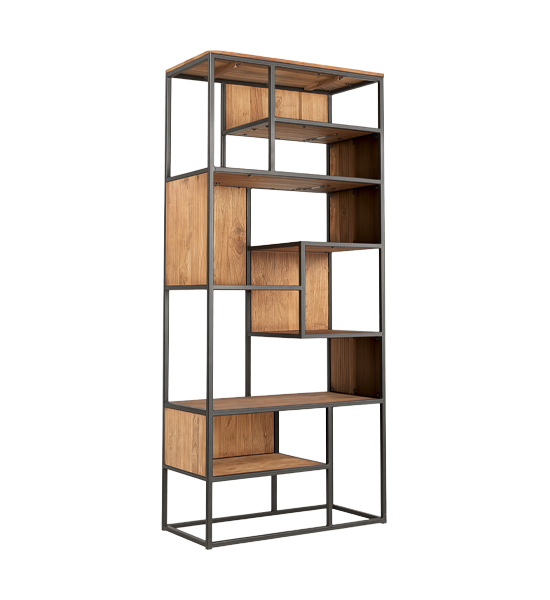
type is the first decision because it determines what the piece can do beyond holding books. our range covers open shelving units, ladder-style racks, multi racks, stacking shelves that can be configured vertically or horizontally, geometric bookracks, and pieces that combine open shelves with drawers or sliding doors. we offer an array of options ranging from contemporary styles to designs with slimline handles and sleek iron frames or legs for a modern industrial character.
each type has its own logic. an open shelving unit is the workhorse: the most storage per footprint, and a natural home for a proper book collection. a ladder rack leans lighter on the eye, suited to a corner or a narrow wall where a full unit would feel heavy. stacking shelves are designed to grow with you and adapt to your changing space or needs; start with two modules and add more as the collection does, upright against a wall or run low along one. geometric bookracks turn the shelving itself into a dynamic display, and hybrid pieces with drawers or sliding doors give you somewhere for the things you would rather not look at every day.
there is one more role worth knowing about. as a general guide, an open rack placed perpendicular to a wall works as a room divider: it zones a studio into sleeping and living areas, or marks where a dining space ends and a workspace begins, whilst letting light and air pass straight through. in open-plan Hong Kong apartments this is shelving doing the work of a wall, without the permanence or the darkness of one.
most customers visit our showroom looking for a bookshelf with drawers to store smaller bits and bobs. they are pleasantly surprised by the versatility of our multi racks, often taking inspiration from our displays for their own homes.
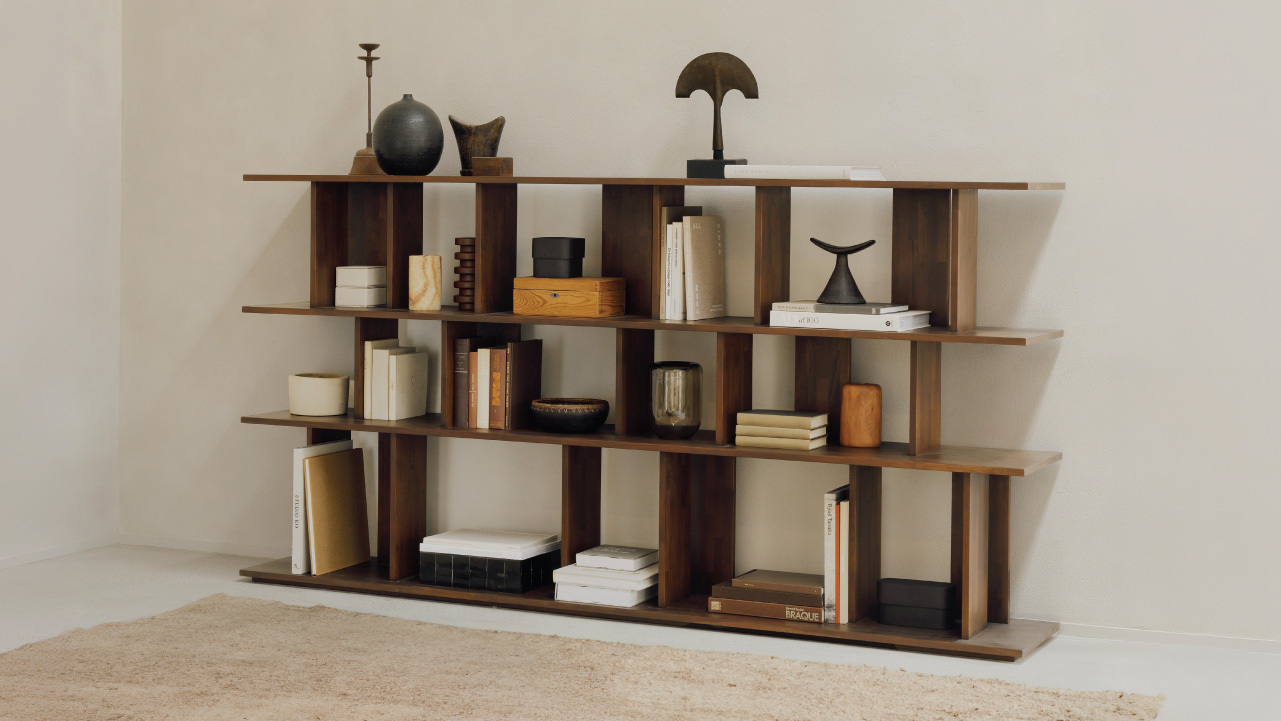
bookshelf types at a glance
| type | what it offers | suited to |
|---|---|---|
| open shelving unit | maximum storage per footprint | serious book collections; living rooms and studies |
| ladder rack | light, leaning profile | corners, narrow walls, smaller rooms |
| stacking shelves | modules configured vertically or horizontally | collections that grow; flexible layouts |
| geometric bookrack | the shelving is the display | statement walls; mixing books with objects |
| shelves with drawers or sliding doors | open display above, concealed storage below | living rooms; anything you want out of sight |
| iron-framed industrial designs | slimline metal frames and legs | lofts, workspaces, contemporary schemes |
shop bookcases & racks


2. size and space: thinking vertically in Hong Kong
in most homes the question is which bookshelf fits the wall. in Hong Kong the better question is how much wall you are willing to give it, because height is the one dimension apartments here have. our bookcases and racks are generally 44–180cm in width, 30–45cm in depth, and 80–220cm in height, which means a tall, narrow unit can hold a serious collection on a vertical footprint not much bigger than a dining chair.
our bookcases and racks at a glance
| dimension | our range |
|---|---|
| width | 44–180 cm |
| depth | 30–45 cm |
| height | 80–220 cm |
depth deserves more attention than it usually gets. a shelf that is too shallow leaves books overhanging; one that is too deep swallows floor space and leaves books lost at the back. the table below is a general guide to matching depth to what you are displaying; always check the listed measurements before you buy.
shelf depth: a general guide
| depth | holds comfortably |
|---|---|
| 20–25 cm | paperbacks, standard novels, small display pieces |
| 25–30 cm | hardcovers, cookbooks, files and folders |
| 30–45 cm | art books, records, baskets, larger display objects |
height brings one practical note. as a general guide, tall freestanding units are worth anchoring to the wall, particularly in homes with young children; it is a small job that takes minutes and lets you load the upper shelves without a second thought. if you do require your piece to be secured to the wall, just let us know. if none of the standard sizes matches your wall, our custom-made options in reclaimed teak are built to your room size, interior style and storage needs.
key measurements for Hong Kong apartments
| measurement | as a general guide |
|---|---|
| clearance in front of shelves | 75–90 cm to browse and reach comfortably |
| clearance for drawers or sliding doors | check the open position, not only the closed footprint |
| doorframe width | 76–80 cm is standard in Hong Kong; check before ordering |
| ceiling height | leave a visible gap above a 220 cm unit so the room can breathe |
above are some of the key measurements that you may want to keep in mind whilst finding your perfect piece. we find that most customers come in with their floor plan or the dimensions they need for the bookshelf – if a single bookshelf doesn’t perfectly fit with their wall, oftentimes they’ll opt for two slim bookshelves instead.
some customers who have purchased bookshelves taller than 200cm are understandably concerned about delivery – particularly whether the piece can fit inside the lift or can be manoeuvred through tight stairwells. our team can help assess your space and determine whether this will be an issue, so that you can explore your options with confidence.
3. open shelves, closed storage, or both?
books are only half of what a bookshelf holds. the other half is everything else: files, photographs, children’s games, the router, the things that accumulate in any lived-in home. deciding how much of that you want on display can determine whether the shelf makes a room feel composed or cluttered.
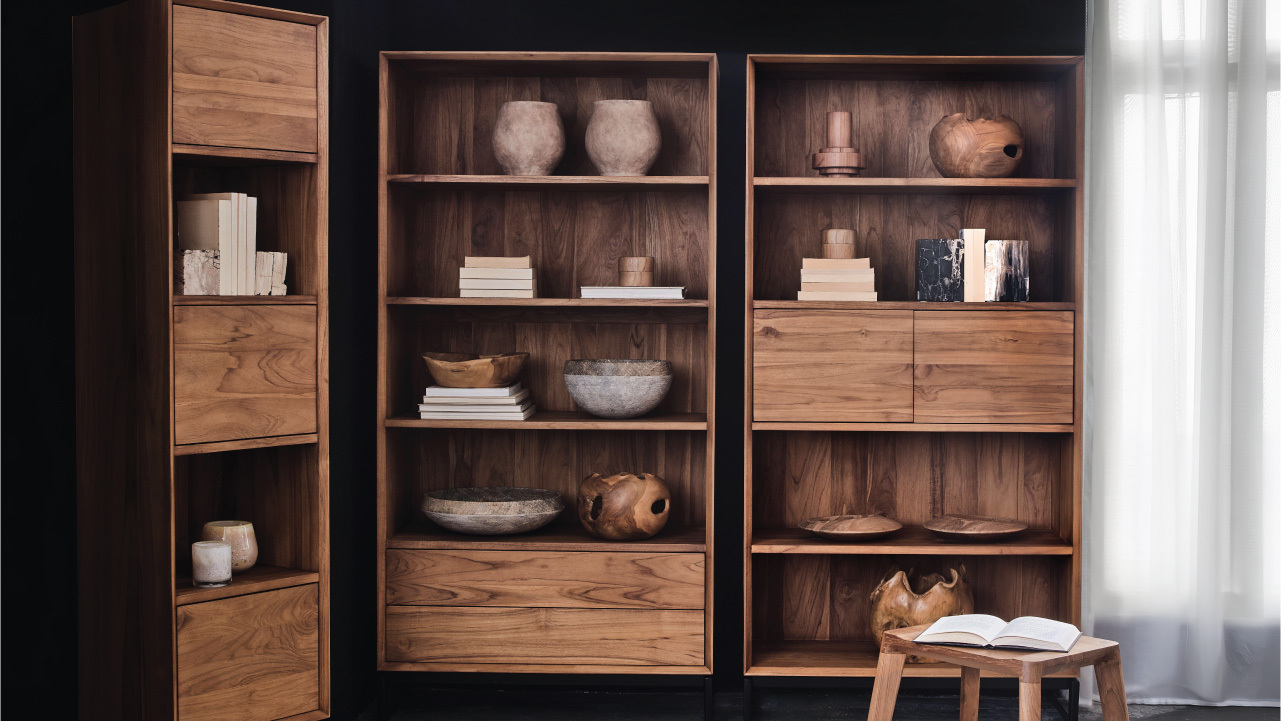
open shelves suit the things you are happy to live with in view: books, ceramics, plants, framed photographs. they keep everything within easy reach and give a room its character. closed storage answers for the rest; some of our designs combine airy open shelves with drawers or sliding doors below, with removable shelves inside, keeping paperwork and cables neatly tucked away whilst your favourite things stay on show.
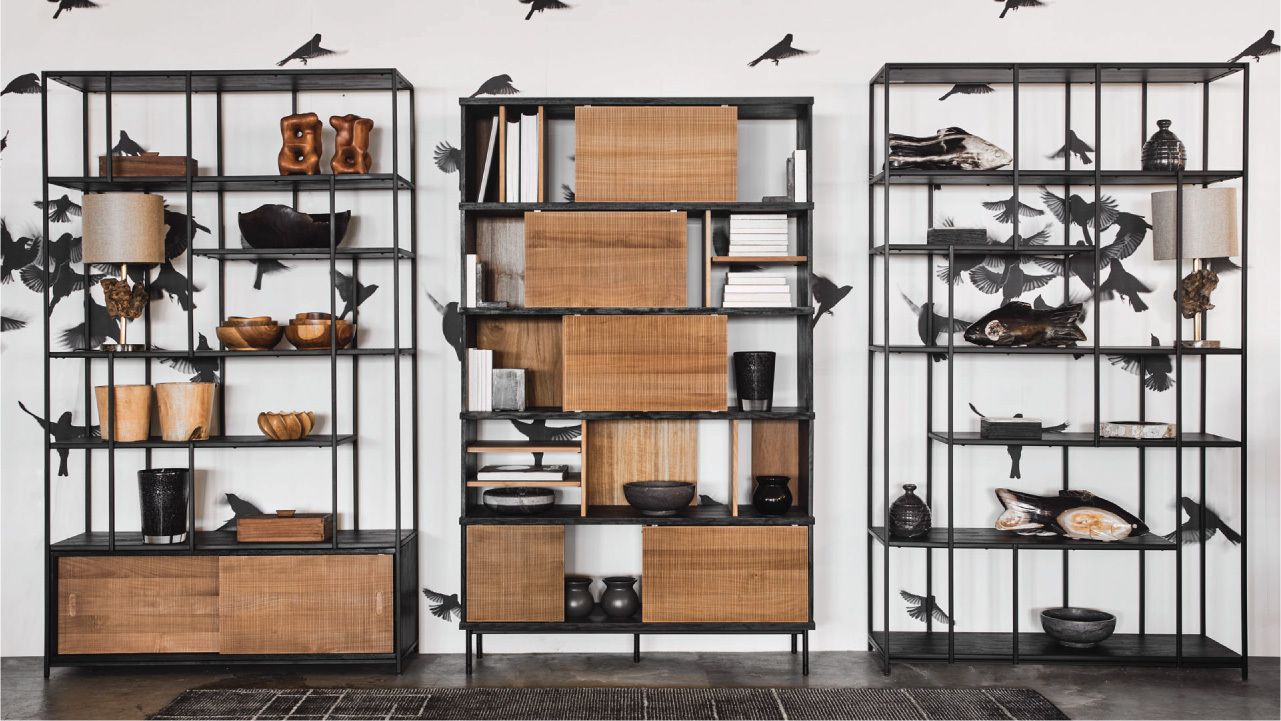
a practical rule we find useful: be honest about the ratio. a household of readers might want nine parts open to one part closed; a family living room often wants closer to half and half. if you are unsure, err towards more closed storage than you think you need; open shelves fill themselves, and drawers forgive.
4. wood, iron and character: materials for Hong Kong
a bookshelf carries weight for decades, so the material is a structural decision as much as an aesthetic one. solid wood shelves hold their line under a full load of books year after year, and every timber we work with is treated throughout sourcing and production to be at home in Hong Kong conditions. our pieces are produced in Indonesia, Serbia and Vietnam by workshops that share the same commitment to sustainability and quality that we hold ourselves.
the materials we work with
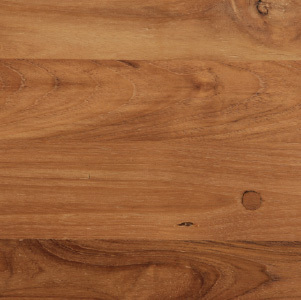
reclaimed teak
weathered surfaces, elegant textures and original markings. salvaged timber: no new trees felled.
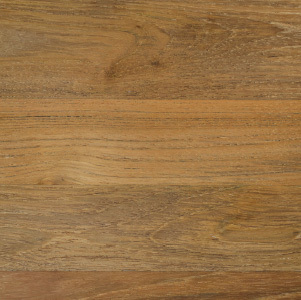
FSC™-certified solid & plantation teak
consistent golden-brown tones; a more uniform grain. certified from responsibly managed forests.
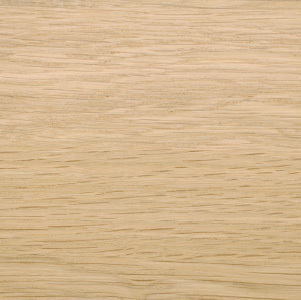
European oak
light, creamy tones with subtle golden-brown grain and a fine, even texture.

mahogany
deep brown hues that give way to a rich, warm and inviting look.
reclaimed teak. lovingly handcrafted from wood salvaged from century-old Indonesian houses through our longstanding partner dBodhi; warm, weathered surfaces and natural markings make each piece truly one of a kind, and teak’s natural durability and oils make it built to last through countless family moments. choose it when you want the shelving to have as much character as what sits on it.
FSC™-certified solid teak and plantation teak. the same natural durability with certified, responsible sourcing from managed forests; a cleaner, more consistent look for classic and contemporary rooms.
European oak. light, creamy tones with subtle golden-brown grains and a fine, even texture; prized for strength, stability and a natural resistance to wear. the natural choice for Japandi, Scandinavian and minimalist schemes, where pale timber keeps a wall of shelving from feeling heavy.
mahogany. a tropical hardwood renowned for its durability, straight grain, and deep brown colour that darkens with age; resistant to moisture changes, which makes it particularly well suited to Hong Kong homes. sustainably sourced.
iron and metal detailing. some designs combine solid wood shelves with iron or metal frames, legs or slimline handles for an industrial touch; the wood does the storing, the metal adds a cool contrast.
materials at a glance
| material | appearance | best style | sustainability |
|---|---|---|---|
| reclaimed teak | weathered, characterful; every piece unique | wabi sabi, rustic, relaxed | salvaged: no new trees felled |
| FSC™-certified teak and plantation teak | golden-brown; consistent grain | classic, contemporary | FSC™-certified forest management, well-managed forests |
| European oak | light, creamy; fine even grain | Japandi, Scandinavian, minimalist | responsibly sourced |
| mahogany | deep brown; darkens with age | traditional, warm contemporary | sustainably sourced |
| wood with iron detailing | timber warmth, metal lines | industrial, loft, workspace | solid wood core |
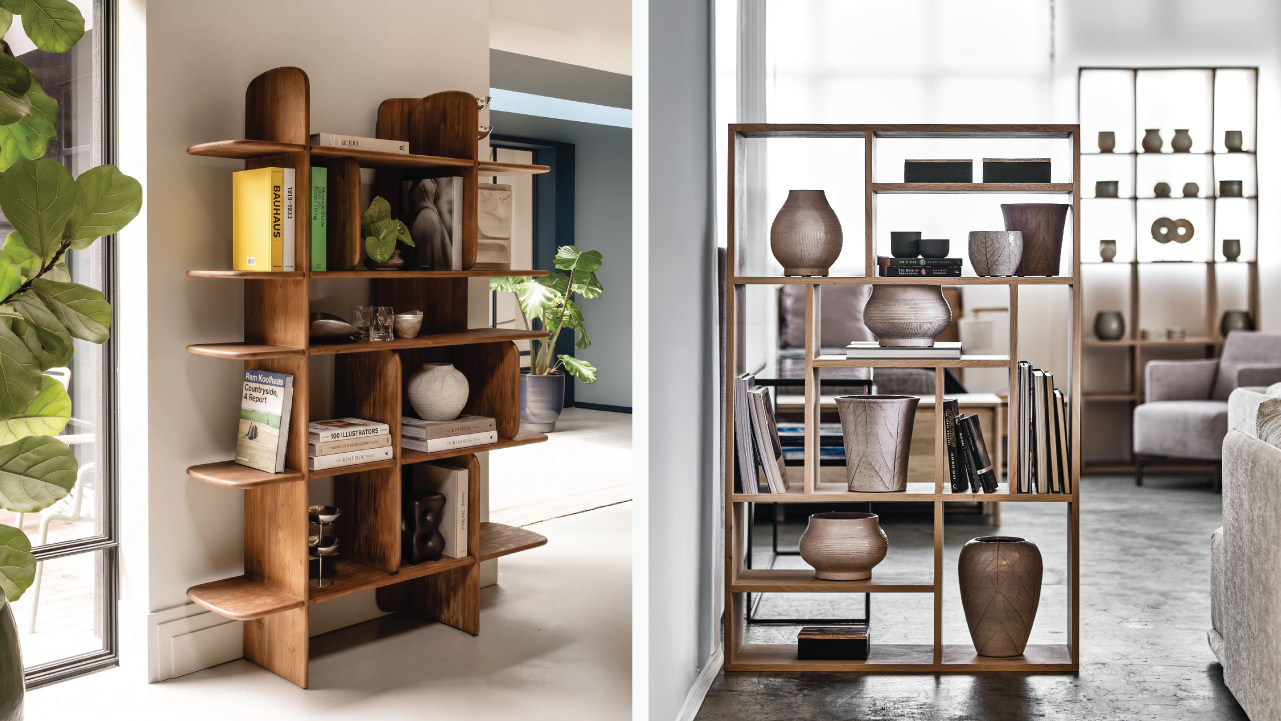
seeing shelving at full scale changes decisions; the difference between a 160cm and a 220cm unit is hard to feel from a photograph, and the grain of reclaimed teak is something you read with your hands. our 25,000 sq ft showroom at Horizon Plaza, Ap Lei Chau holds the widest selection of bookcases and racks in Hong Kong, styled and loaded so you can judge each design as it would live in your home.
Kate Babington, Managing Director at TREE
“bookshelves are a wonderful way to express your personality. they work especially well in Hong Kong homes, where space is often at a premium, as they make use of vertical space that might otherwise go to waste. from displaying your favourite books – styled vertically or horizontally for added visual interest – to showcasing decorative pieces collected from your travels, or even incorporating potted greenery to bring a touch of the outdoors in, there are endless ways to create a thoughtfully curated display that feels uniquely yours.”
5. caring for your bookshelf in Hong Kong
a solid wood bookshelf asks very little of you, and it looks after your books while it is at it. our shelving carries natural oil or water-based protection: breathable finishes that let the timber respond gradually to Hong Kong’s seasons rather than sealing it shut. day to day, care is nothing more than a wipe with a slightly damp cloth, and the books themselves benefit from the same conditions the wood enjoys: steady humidity and air that moves.
Hong Kong · Spring care
Spring in Hong Kong can get particularly humid, with indoor humidity spiking above 90%, and that is when your bookshelf and your books appreciate a little extra care. a dehumidifier or air conditioner keeping the room between 50% and 60% sees the season out comfortably, and your paperbacks will thank you for it as much as the timber does.
- keep dust off: run a slightly damp cloth along the shelves every few weeks; the tops of books and the upper shelves collect dust quietly, so include them.
- give the wood steady conditions: solid wood is happiest with stable temperature and humidity. position the unit so it is not in a direct air conditioning draught, and let air circulate around and through it.
- run a dehumidifier in Spring: aim for indoor humidity of 50–60% through the humid months; wood, paper and photographs all prefer the same range, so one machine cares for everything on the shelves.
- keep it hydrated in Winter: if you run home heating in the cooler months from November to March, a cup of water placed nearby helps maintain ambient humidity whilst the air is dry.
- check in once a year: monitor the room’s conditions from season to season and glance over the shelves and joints annually; solid wood moves gently with the seasons, and if anything ever needs attention, contact us for guidance first.
our TREEtment manual covers all of this in detail, from everyday cleaning to seasonal routines; download it on our after care page. and if you are ever unsure what your shelving needs, our team is always happy to talk it through for your specific home.
what size should a bookcase be?
start from the wall, not the bookcase. measure the width you can give it and the height of the room, then remember that in Hong Kong the most efficient direction is up: our units are generally 44–180cm wide and up to 220cm tall, so a narrow footprint can still hold a serious collection. as a general guide, leave 75–90cm of clearance in front so you can browse comfortably, and check your doorframe (76–80cm is standard in Hong Kong) before ordering.
how deep should a bookshelf be?
it depends on what it will hold. as a general guide, 20–25cm suits paperbacks and standard novels, 25–30cm takes hardcovers, cookbooks and files, and 30–45cm handles art books, records and baskets. our bookcases and racks are generally 30–45cm deep across the range, which covers everything from novels to display pieces without swallowing floor space.
do bookshelves need to be anchored to the wall?
as a general guide, we recommend anchoring tall freestanding units, particularly in homes with young children. it is a small job that takes minutes, and it lets you load the upper shelves with heavy books without a second thought. lower units and stacking shelves configured horizontally are inherently stable and generally do not require it.
how much weight can a bookshelf hold?
books are heavier than they look; a full shelf of hardcovers can weigh 30 kilograms or more. this is where solid wood earns its keep: solid timber shelves hold their line under a full load year after year, whilst thin veneered boards can bow over time. as a general guide, spread the heaviest books across lower shelves and let the upper shelves carry the lighter things.
can a bookshelf work as a room divider?
very well. an open-backed rack placed perpendicular to a wall zones a studio or open-plan apartment into two spaces whilst letting light and air pass straight through, and it stores your books while it does it. it is one of the most space-efficient moves available in a Hong Kong home: a wall’s worth of separation on 30–45cm of depth, with storage on both sides of the line.
how do I look after books and a bookshelf in Hong Kong humidity?
mostly by giving them steady conditions, and your bookshelf meets you halfway: the timber we use is treated throughout sourcing and production for Hong Kong conditions, our reclaimed teak has already spent a century acclimatising in tropical Indonesia, and mahogany is naturally resistant to moisture changes. your books prefer the same conditions the wood does, so a dehumidifier or air conditioner holding the room at 50–60% through the humid months cares for the collection and the furniture together.
how do I style a bookshelf like a designer?
mix books with objects, and leave space. alternate vertical rows with horizontal stacks, use a stack as a plinth for a ceramic or a plant, and keep roughly a fifth of each shelf empty so the eye can rest. group by colour if you like the look, by subject if you like to find things. our article on creating visual interest in your home goes deeper on layering and balance.
what is the best material for a bookshelf?
for a piece that carries real weight for decades, solid wood: it holds heavy loads without bowing and can be cared for rather than replaced. from there it is a question of character. reclaimed teak brings weathered, one of a kind surfaces; European oak keeps a large unit feeling light; mahogany deepens in colour with age and takes Hong Kong’s moisture shifts in its stride; and iron-framed designs add an industrial touch. you can browse our full selection of bookshelves at our showroom, loaded and styled, so you can experience them in person.